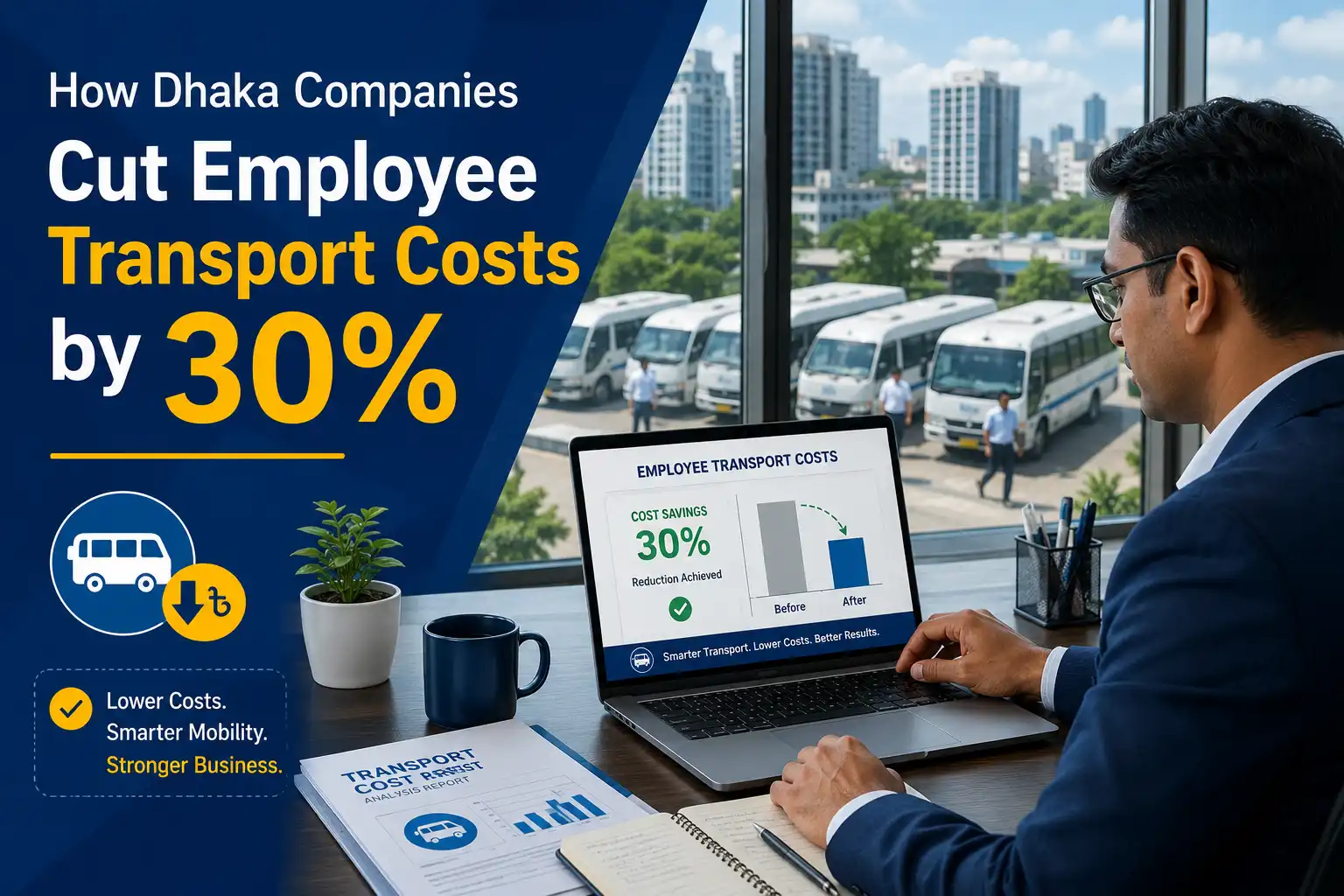
Employee transport is a genuinely significant recurring cost line for most mid-size and larger companies in Dhaka, and it's also one of the easier budget items to optimise once you actually look closely at where the money is going. Companies that review their transport arrangement properly — rather than simply renewing the existing contract each year — routinely find 20-30% in achievable savings without cutting service quality for employees. This guide walks through the specific, practical strategies that produce these savings, with a real before/after cost comparison.
Where Transport Budgets Usually Leak
Before any optimisation strategy makes sense, it helps to understand where the waste typically accumulates. The most common sources are: vehicles routed inefficiently with overlapping pickup zones that could be consolidated, vehicle classes larger than actual passenger loads require, billing structures that don't match actual usage patterns, and multi-year contracts that were never renegotiated as the company's headcount or routes changed.
Individually, each of these might represent a modest inefficiency; together, they routinely add up to a meaningful percentage of the total transport spend.
Strategy 1 — Route Consolidation
Many companies, particularly those that have grown organically, end up with transport routes designed around historical pickup patterns rather than current employee addresses. A proper route audit — mapping where employees actually live against the vehicles currently assigned — frequently reveals overlapping routes that could be consolidated into fewer vehicles covering the same employees, directly reducing the number of vehicles (and associated fixed costs) needed.
This is usually the single largest source of savings and the one most companies haven't revisited in years.
Strategy 2 — Right-Sizing Vehicles to Headcount
A microbus or larger vehicle running at half capacity on a given route costs meaningfully more than a smaller vehicle would for the same actual passenger count. Reviewing actual daily ridership against assigned vehicle capacity — not the capacity the route was originally designed for — often reveals opportunities to downsize specific routes to smaller, cheaper vehicles without affecting any employee's actual transport quality.
Strategy 3 — Switching From Per-Vehicle to Per-Head Billing
For companies with variable daily ridership — where not every assigned seat is used every day — per-head billing (paying based on actual employees transported) can work out considerably cheaper than a fixed per-vehicle rate that assumes full occupancy regardless of actual usage. This isn't the right model for every company; fixed, high-occupancy routes may genuinely be cheaper on a per-vehicle basis.
But for routes with meaningful day-to-day variation, it's worth explicitly modelling both structures against your actual usage data before assuming one is automatically better.
Strategy 4 — Negotiating Annual Contracts
Vendors typically offer meaningfully better rates for a committed annual contract compared to month-to-month renewal, since a longer commitment reduces the vendor's own uncertainty and administrative overhead.
If your transport needs are reasonably stable, locking in an annual rate — with a fair mechanism for adjusting if fuel prices shift significantly, referencing published Bangladesh Petroleum Corporation (BPC) pricing — is usually one of the more straightforward wins available, and one companies frequently leave on the table by defaulting to shorter renewal cycles out of habit rather than any specific need for flexibility.
Real Example — Before/After Cost Table
| Cost Factor | Before Optimisation | After Optimisation |
|---|---|---|
| Vehicles for 60 employees | 8 microbuses (partial capacity) | 6 microbuses (consolidated routes) |
| Billing structure | Fixed per-vehicle | Per-head with minimum guarantee |
| Contract term | Month-to-month | Annual, fixed rate |
| Approximate monthly saving | — | 25-30% reduction |
This is an illustrative example based on typical patterns seen across similar-sized corporate transport contracts; your actual achievable savings depend on your specific routes, headcount, and current contract terms.
Reviewing Your Buy-vs-Rent Decision Alongside Transport Costs
For companies also weighing whether to purchase dedicated company vehicles instead of renting, it's worth reviewing this decision alongside your transport cost optimisation review rather than treating them as separate questions — the right fleet strategy for a growing company can shift meaningfully once route consolidation and billing restructuring are factored in. See our detailed comparison of renting versus buying a company car for the full cost breakdown across both approaches.
Combining Strategies for Compounding Savings
The strategies above aren't mutually exclusive, and the largest total savings typically come from combining several at once rather than picking just one. Route consolidation reduces the vehicle count; right-sizing reduces the per-vehicle cost for the vehicles that remain; and an annual contract locks in a lower rate on the resulting, optimised arrangement.
Companies that address all three together — rather than tackling them piecemeal over separate budget cycles — see the full 25-30% range referenced in the cost table above, while those addressing only one factor typically see savings closer to the lower end of that range.
When Cost-Cutting Can Go Too Far
It's worth flagging a genuine risk here — pushing cost reduction too aggressively can start to erode the actual employee transport experience, particularly if right-sizing tips into genuine overcrowding or route consolidation adds meaningfully longer commute times for some employees.
The goal of a proper transport cost review isn't the lowest possible number; it's eliminating genuine waste — overlapping routes, oversized vehicles, and unfavourable contract terms — without degrading the actual service employees rely on daily. A vendor experienced in this kind of review, like our employee pick and drop service, can usually help identify where the line sits for your specific situation.
Getting Started on Your Own Cost Review
The first practical step is simply mapping current routes against actual employee addresses and daily ridership — most of this data already exists somewhere in HR or facilities records, even if it hasn't been consolidated into a single view before. Once you have this map, the four strategies above become considerably easier to evaluate concretely against your specific situation, rather than as abstract recommendations.
Building a Business Case for Transport Optimisation Internally
If you're the one proposing this review internally, it helps to frame it as a straightforward cost-avoidance exercise rather than a disruptive overhaul — most of the changes above (route consolidation, right-sizing, contract restructuring) happen at contract renewal and don't require any change employees would even notice day-to-day, aside from potentially a slightly adjusted pickup order on a consolidated route.
Presenting the before/after comparison with your own company's actual numbers, rather than a generic industry example, tends to be considerably more persuasive to finance leadership than an abstract savings percentage.
How Often to Revisit Your Transport Contract
Even a well-optimised transport arrangement drifts out of alignment with actual company needs over time — headcount changes, office relocations, and new hires living in different parts of the city all gradually shift the ideal route structure away from what was set up initially. A sensible cadence is a full route and cost review at each contract renewal, typically annually, rather than assuming an arrangement that was efficient two or three years ago is still optimal today.
Companies that build this review into their standard renewal process, rather than only revisiting transport costs reactively when a budget review flags rising expenses, tend to stay closer to genuinely optimal spending year over year.
Working With a Vendor Who Understands This Process
Not every transport vendor is equally equipped to support this kind of optimisation conversation — some are set up primarily to fulfil a fixed contract as specified, without much appetite for proactively suggesting route or billing changes that might reduce their own revenue. When evaluating vendors, or reviewing your current one, it's worth asking directly whether they've supported this kind of cost review for other corporate clients and what the actual outcomes looked like.
A vendor willing to have this conversation openly, even knowing it may result in a smaller contract, is generally a better long-term partner than one who avoids the topic.
Frequently Asked Questions
What's the fastest way to reduce employee transport cost?
Route consolidation typically produces the fastest and largest single improvement, since it directly reduces the number of vehicles required without any change to billing structure or contract term.
Does switching to per-head billing actually save money?
It can, particularly for routes with variable daily ridership — but it's not universally cheaper, so model both structures against your actual usage data before switching.
How much can route consolidation save?
This varies by how inefficient current routing is, but companies that haven't reviewed routes in several years often find 10-15% savings from consolidation alone.
Is an annual contract cheaper than monthly renewal?
Generally yes, since vendors typically offer better rates for a committed longer-term contract, though it's worth building in a fair fuel-price adjustment mechanism.
Can transport costs be reduced without cutting service quality?
Yes — the strategies above target genuine inefficiency (overlapping routes, oversized vehicles, unfavourable billing) rather than reducing the actual transport service employees receive.
Want to know exactly where your company can save? Get a free transport cost audit — we'll map your current routes and usage against these four strategies and show you exactly where the savings are. See our corporate car rental service for current package options.