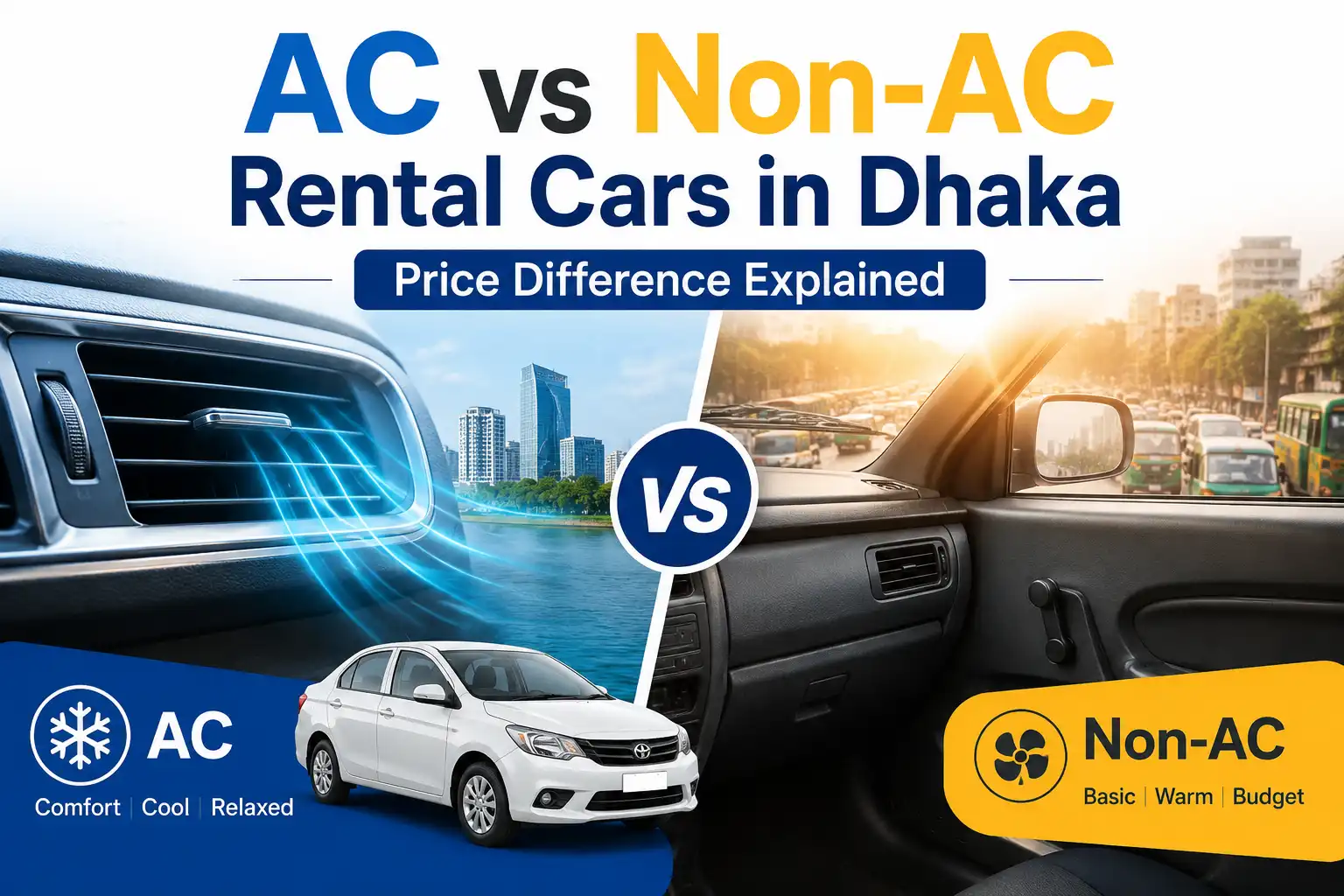
A question that comes up more often than you'd expect: is non-AC car rental actually available in Dhaka, and would it genuinely be cheaper? Given Dhaka's climate, the honest answer is that non-AC rental has become quite rare in practice, and the modest fuel saving rarely justifies the comfort trade-off for most renters. This guide explains the real price difference where non-AC options do exist, why AC has become the standard default, and whether the fuel consumption difference is actually as significant as commonly assumed.
Is Non-AC Rental Still Common in Dhaka
In practice, no — the overwhelming majority of rental fleets in Dhaka, including ours, operate exclusively AC-equipped vehicles as standard. Given Dhaka's heat and humidity for most of the year, demand for non-AC rental has essentially disappeared from the mainstream market, and most providers no longer maintain a separate non-AC fleet at all. Where a non-AC option technically exists, it's typically an older vehicle nearing the end of its rental service life rather than a deliberately maintained budget category.
Price Difference — AC vs Non-AC
Where a genuine non-AC option is available, the price difference is typically modest — often just 5-10% below the equivalent AC rate — rather than the dramatic discount some renters expect.
This modest gap reflects the reality that AC isn't really an optional add-on feature in a modern rental vehicle; it's effectively a standard component of the car itself, and removing its use doesn't meaningfully change the vehicle's underlying cost structure the way, say, choosing a smaller engine size might.
Why Most Modern Rental Fleets Are AC-Only
Beyond simple customer preference, there are practical fleet-management reasons most providers have moved entirely to AC-equipped vehicles. Maintaining two separate categories (AC and non-AC) of otherwise similar vehicles adds real operational complexity — separate booking categories, separate maintenance considerations, and a shrinking customer base actually requesting the non-AC option specifically.
It's simply more efficient, and better for customer satisfaction overall, for a provider to standardise on AC across the full fleet rather than maintain a legacy non-AC category serving a very small and steadily declining segment of demand.
Fuel Consumption — Does AC Use Really Cost More
Running a car's air conditioning does increase fuel consumption to some degree, but the actual impact is more modest than commonly assumed — typically in the range of a small percentage increase in overall fuel use during city driving, rather than a dramatic jump.
Given current fuel pricing published by the Bangladesh Petroleum Corporation (BPC), this translates to a genuinely minor cost difference across a typical day's driving, which is part of why the price gap between AC and non-AC rental (where it exists at all) tends to be small rather than substantial.
Comfort and Safety Considerations Beyond Just Cost
Beyond the modest cost consideration, there's a genuine practical safety angle worth mentioning: driving in Dhaka's heat without AC, particularly during the hotter months, can contribute to driver fatigue and reduced alertness over a longer trip — a real consideration for any journey involving extended time behind the wheel, whether self-drive or for the comfort and alertness of a chauffeur-driven trip's driver.
This is one of the less commonly discussed but genuinely valid reasons AC has become the practical default rather than simply a comfort preference.
When Non-AC Might Still Make Sense
The rare cases where a non-AC vehicle might genuinely make sense are limited to very short, occasional trips where minimising cost is the overriding priority and comfort is a secondary concern — and even then, the actual savings are modest enough that most renters find it isn't worth the trade-off. For virtually any trip involving more than a very brief period in the vehicle, or during Dhaka's hotter months specifically, AC is worth the marginal additional cost for the vast majority of renters.
What to Expect When Requesting a Quote
When requesting a rental quote today, you can generally assume AC is included as standard rather than needing to specify it explicitly — this has become the default baseline expectation across the market. If cost is a genuine concern, it's more productive to discuss vehicle class (a smaller, more fuel-efficient sedan versus a larger vehicle) or rental duration and structure (monthly versus daily) as the more meaningful cost levers, rather than focusing on AC versus non-AC, which represents a comparatively minor factor in your overall rental cost.
How This Compares to Other Cost-Saving Strategies
If your goal is genuinely minimising rental cost, there are considerably more impactful strategies available than seeking out a non-AC vehicle — choosing a smaller, more fuel-efficient sedan like the Toyota Axio over a larger vehicle class, opting for a monthly contract if your need is recurring rather than paying daily rates repeatedly, and comparing quotes across a few providers for the same vehicle class and terms.
Any of these strategies will typically produce a considerably larger saving than the modest gap between AC and non-AC rental, making them a more productive focus for cost-conscious renters.
A Brief History of Why This Question Still Comes Up
Non-AC rental was more common in Dhaka's car rental market years ago, when AC was still considered more of a premium feature rather than a baseline expectation, and older, lower-cost vehicle categories often lacked functioning air conditioning as a genuine cost-saving measure for budget-conscious renters.
As the overall vehicle fleet across Bangladesh has modernised and AC has become standard equipment on virtually all vehicles manufactured or imported in recent years, the practical distinction between AC and non-AC has largely disappeared from the market — which is exactly why the question persists in search behaviour even though the actual answer has become largely moot in practice.
What Renters Are Often Really Asking About
When people search for information about AC versus non-AC pricing, they're often really asking a broader question about how to reduce their overall rental cost, rather than specifically wanting a non-AC vehicle.
If cost reduction is your actual goal, it's worth reframing the question toward the factors that genuinely move the needle — vehicle class selection, rental duration and structure, and comparing quotes across providers — rather than focusing on a factor (AC) that, as covered above, makes only a marginal difference to the total cost in most cases.
Checking AC Function Before You Drive Off
Since AC is now a standard, expected feature, it's worth actually testing that it works properly during your vehicle condition check at pickup, rather than assuming it's functional simply because the vehicle is a modern model.
A malfunctioning AC unit in Dhaka's climate is a genuine comfort issue worth catching immediately rather than discovering partway through your trip — if you notice any issue, raise it before driving off so the provider can address it or offer an alternative vehicle rather than dealing with it after you've already left the pickup point.
AC Considerations for Self-Drive Renters Specifically
For self-drive renters, AC function matters not just for comfort but for genuine driving safety and alertness over a longer self-driven trip, particularly during Dhaka's hotter months. If you're self-driving, it's worth being even more attentive to confirming AC function at pickup than a chauffeur-driven renter might be, since you're the one who'll be directly affected by any malfunction over the course of your own driving, rather than a company driver used to managing this kind of issue as part of their regular work.
How This Fits Into Your Overall Rental Decision
Ultimately, AC availability is one of the smaller decision points in choosing a rental vehicle today, having effectively become table stakes rather than a genuine point of comparison between options.
The factors genuinely worth spending comparison time on are vehicle class and condition, the specific rental terms (km limit, fuel policy, deposit), and overall provider reliability — all covered in more depth throughout our other rental guides. Treating AC as a settled, standard expectation frees up your attention for the comparisons that actually affect your total cost and experience.
Frequently Asked Questions
Is non-AC car rental cheaper in Dhaka?
Where available at all, non-AC rental is typically only 5-10% cheaper than the equivalent AC rate — a modest difference rather than a substantial discount.
Do all rental cars in Dhaka have AC by default?
Effectively yes — the vast majority of modern rental fleets, including ours, operate AC-equipped vehicles as standard, with non-AC options largely disappeared from the mainstream market.
Does using AC significantly increase fuel cost?
The increase is real but modest — typically a small percentage rise in overall fuel consumption during city driving, translating to a minor cost difference across a typical trip.
Is AC included in the base rental price?
Yes, for virtually all modern rental bookings — AC is treated as a standard vehicle feature rather than a separately priced add-on.
Can I request a non-AC option to save money?
You can ask, but given the modest actual savings and the practical safety and comfort trade-off, most renters find it isn't genuinely worth pursuing compared to other, more impactful cost-saving strategies.
All our fleet comes AC-equipped as standard — check our current pricing page for current rates across every vehicle class, with no separate AC premium to worry about.